 |
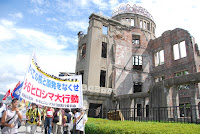
| Preserved building near ground zero in Hiroshima--and protesters! |
Cindy Sheehan's Soapbox
July 31, 2011
Guest: Arnie Gunderson
CS: Cindy Sheehan
AG: Arnie Gunderson
CS: Welcome back to Cindy Sheehan’s Soapbox. I am your host Cindy Sheehan and you are listening at CindySheehansSoapbox.com.
This is our last show for a couple of weeks because I will be heading to Japan—I have been invited by people who are anti-nuclear power and anti-nuclear weaponry. They are also pro-worker and they’ve been working really hard to hold the government of Japan and the power company TEPCO accountable for the Fukushima disaster.
I will be in Hiroshima on the day the US bombed Hiroshima with an atomic weapon. I will be in Nagasaki on that day a few days later on the anniversary of the day when the US dropped and A-bomb on Nagasaki. I will be going to Okinawa because the US has a lot of military bases there and the people of Japan are opposed to that and I always stand with the people. Then I will be going to Tokyo to do some mass actions against nuclear power and to hold the government of Japan accountable for the disaster that they have been very slow and ineffective in responding to.
So before I head to Japan I wanted to have an expert on the nuclear power and nuclear disaster issue on. Our guest today is Arnie Gunderson. Arnie is an energy advisor with 39 years of nuclear power engineering experience. He is a former nuclear energy Vice President and he earned his bachelors and masters degrees in nuclear engineering.
Arnie Gunderson, welcome to Cindy Sheehan’s Soapbox.
AG: Thanks for having me.
CS: It’s great to have you on. You do quite a bit of media concerning the nuclear power issue. The reason I am having you on is because next week I’m heading for Japan. I am going there with people who have invited me that are against nuclear power, against nuclear bombs and things like that. I am going to Nagasaki, Hiroshima, Okinawa and Tokyo.
First of all I wanted you to give us an update what’s happening in Fukushima and about the dangers of the emissions and things that are still happening in Japan.
AG: Okay, again, thank you for having me. The Fukushima reactors continue to emit radiation every day. The Japanese estimate that they are emitting 24 billion disintegrations per second every day—in addition to what they have spewed out over the last 100 days. So it is a significant number in and of itself. But more importantly there is an awful lot of contamination on the ground.
All throughout Japan we are finding concentrations higher than they were at in Chernobyl as far away as 50-60 miles from the Fukushima reactor. A lot of that has fallen onto grass and straw, which is being fed to cattle, and now the cattle are becoming contaminated.
So the Japanese haven’t got a handle on the problem yet. Their government has been really slow to recognize the problem and the press has been complacent in warning people of the problem. There is a lot of contamination throughout all of Northern Japan including Tokyo.
CS: So, I am not so sure, I work with the activists there from the Doro Chiba, I not sure if you know who they are? They are a pretty radical labor union, but they’re also trying to hold the Japanese government accountable and TEPCO accountable for the disaster. I not so sure they were slow to recognize the problem, but it seems they have very slow to react to the problem.
AG: I think what’s happening is a bunch of finger pointing. The Japanese government wants TEPCO to step up to the plate and be responsible for everything. TEPCO is focused on site and is really leaving the offsite work to the Japanese.
There’s billions and billions of dollars here. I estimate to clean this thing up it’s going to be about 200 billion dollars. That’s just not the site but the contaminated lands that are inland. If TEPCO were the one to do all that they would go bankrupt. So I think there is a real hesitancy by the Japanese government to bankrupt TEPCO so therefore they are not pushing them as hard as they should. But at the same time the Japanese government is not stepping up and saying if TEPCO is not doing these things we need to.
So what you’ve got is a bunch of prefectures, some of which are active and some of which don’t know very much because this is not a science that every prefecture has in its bag of tricks. So each prefecture is doing it’s own thing. We had an example of this in an area near Tokyo a citizen went out on the street and found a radioactive hotspot, had it analyzed, paid his own money for a laboratory to analyze this spot and it was 50 thousand disintegrations per second in the area of this hotspot. Well he brought the lab report that he paid for to the mayor of the town, the mayor said, “I don’t care”!
CS: Wow.
AG: Yes, it’s a real concern.
CS: Do you have any advice for me going right into, I live on the West Coast? I live very close to San Francisco and I feel like we have had a little bit of the fallout in California from Fukushima. But do you have any advice for me traveling to Japan at this time?
AG: Let’s talk to you about my advice for you in Japan verses my advice for people on the west coast. My advice for you going to Japan is don’t buy the local food. I would stay away from pretty much everything grown in Northern Japan. Even in Southern Japan Tea is contaminated. But in general most of the Northern Japan products are contaminated. They already leave their shoes at the door so the issue of taking outside contamination in is not as significant.
I am telling all my friends in Japan that they should damp dust. Don’t dry dust because all that does is through the radiation back up. But damp dust all the surfaces in your house frequently and change the filters in your air conditioner frequently, your cabin filter in your car frequently. We’ve gotten air filter for cars that are just littered with radioactive particles.
It’s important so you have to go and you have to be there but you can take some precautions to make sure you are avoiding as much of the radiation as you can.
CS: I was born in 1957. I was born in Los Angeles and there’s proof, well we know that they were doing above ground nuclear testing during that time in Nevada. There were studies that show that the fallout blew over Southern California--do these types of things contaminate us all at this point? Is it a natural, well it’s not natural but is it normal that at this point human on this planet have been contaminated by some kind of radiation?
AG: In LA in the late 50’s there was a nuclear meltdown in a research lab that was covered up for about 30 years. The residents near LA experienced more than your average fallout as far as a result of a test reactor and the meltdown of it—there are small amounts of radioactive cesium in the water and strontium—in the water from bomb testing and from Chernobyl. But what Fukushima has done is dramatically increased those numbers worldwide.
So, yes there is already some radioactivity. It decays away with time. So the bomb testing, the radiation, one, has spread out globally now, and two it’s almost decayed away now to about a quarter of what it was at the peak in the 60’s. Where as Fukushima has not spread out globally yet and it hasn’t decayed away. So there’s a lot more of these radioactive particles in the air from Fukushima than there was before Fukushima--especially on the West Coast.
Our website a website, Fairewinds, and we actually had a piece on radioactive contamination detected in Seattle and that was back in April. And I think there were someone washouts, rainouts in British Columbia just last weekend. So the source of the radiation hasn’t been capped and of course the first piece of land it hits when it comes across the pacific is the West Coast. So I don’t think you are out of the woods yet.
CS: I also noticed on your website you had suggestions for people on the West Coast. Is it basically the same as suggestions you had for the people of Japan?
AG: It’s pretty similar but we don’t have contaminated beef yet, and I don’t think we will. So the issue of eating the beef is not a problem on the West Coast.
Over time I am going to be very concerned about tuna and salmon. But it takes a while for Tuna to swim across the pacific and the Salmon also. So you get at the top of the food chain, the radioaction will what they call, bio-accumulate. So the large fish that ate the smaller fish that ate the smaller fish will over time accumulate large quantities of cesium. But for the next year or so I think it is okay to eat the tuna and salmon from the west coast. What we need is the FDA to analyze it and they have refused to analyze the fish coming into market in the United States.
CS: We see a similar thing happening here in the United States after the after the oil well exploded in the Gulf of Mexico with them refusing to test the shrimp and other seafood from that area.
AG: You’re absolutely right. One of the researchers I am working with on the Fukushima data is also involved in measuring what’s in the shrimp. The government is making it extremely hard for good scientist to take good data. Basically they’re allowing BP to control the field and control the information coming out of the oil fields. You know I think our government; basically lobbyists have so fundamentally altered the way government should work that I don’t think it is working in our best interest right now.
CS: I talked to my colleagues in Japan and their problems with handling Fukushima and TEPCO sounds almost exactly the same as the problems we are having in the US trying to deal with BP and the Gulf disaster. It seems like it is the same kind of forces at work here.
AG: And it started on day one. If you remember Fukushima the Japanese said it isn’t as bad as Three Mile Island. And then about 3 weeks later they said, well it might be as bad as Three Mile Island. Then about a month later they said, on my God it is as bad as Chernobyl. So they underestimated the amount of radiation getting into the environment. That happened with BP too. They underestimated the size of the leak for weeks. Independent scientist was saying it was bad and BP was underestimating. So it started on day one in both cases. I absolutely agree with you.
CS: I wonder if the underestimation is intentional or what because we just had a small microcosm of this happen just a few miles away from me yesterday. A plastic company that makes plastic crates caught on fire and it was this horrible fire--this dark black smoke pouring out of this fire. The wind blew it over my house. So I have this black cloud of toxic chemicals over my house and the news was just saying, if you live within a mile of the plant you should, I think they were calling it shelter and something where you close all the windows and turn off your air conditioning. However, it was 3 o’clock in the afternoon and it looked like 9 o’clock at night at my house. But the news was saying it was safe if you’re past one mile. Is it intentional or are these people just stupid?
AG: I’ve studied Three Mile Island, I’ve studied Chernobyl and I’ve studied this one. I think human nature is too, I think our gut reaction is to think it is really not as bad as it is. So all of these people in authority down play it because they don’t want to create a panic or look like they are overreacting. When you have a bunch of bureaucrats their first reaction is to protect the autocracy and then they will protect the public as opposed to the other way around. But I think none of them want to go out on a limb and say, “my God this is really bad,” like they should have at Three Mile Island, like the should have at Chernobyl and now they should have at Fukushima. It’s the way bureaucrats work in an emergency.
CS: So you have also said that it is very possible that a disaster like Fukushima could happen here in the United States. Can you explain that and also tell my listeners anything we can do avert that kind of disaster that we can do. Not the companies that build the nuclear power plants, not the companies that profit off of them and not the government that keeps on telling us the it is safe.
AG: There are 23 reactors in the United States that are exactly like Fukushima. Those are on the east coast and the middle of the country. None are in California. But the ones that are exactly like Fukushima have a containment unit called the Mark 1 containment and now we are up to the Mark 4 so we’re four generations better on the containments. The Mark 1 when they built it the NRC knew it was a bad design and there are actually letters in the NRC saying we never should have licensed this.
So for the last 40 years it has been one band-aid fix after another on this Mark 1 design. And at Fukushima even with these Band-Aid fixes all three containment units blew up. The containments don’t work. I think that we need to insist that the Nuclear Regulatory Commission do its job and unfortunately that’s not enough. We need to get a hold of our congress people individually and say; I don’t care how much a lobbyist is paying you for campaign contributions. I need you to pay attention to the NRC and get them to protect the public.
The other part of it is the nuclear spent fuel is stored indoors in spent fuel pools right now. It should be stored in what is called dry cast storage. Fukushima had both and the dry cast worked just fine but the fuel pools were very precarious. So we need to move into dry cast storage to protect the public.
Now on the west coast you have Diablo Canyon, which is right near a fault. And actually the public near Diablo Canyon pushed very hard to get the NRC to pay attention and they didn’t for years the NRC said it’s not a problem. But after Fukushima the NRC turned and now said. “oh my God this might be a problem.” We need four more years to analyze it. So unfortunately it takes an accident to get their attention.
A little further south down at San Onofre they only have a 25 ft tsunami wall. Obviously Fukushima told us we need a higher tsunami wall than that.
But individually with the Nuclear Regulatory Commission the deck is stacked with major industry affecting policy and the public basically not affecting policy. So next time you see your congressperson in a mall or something like that shaking hands tell them, “I need you to pay attention to this and I don’t care what the industry is saying. You’re not looking out for our best interests.”
CS: Then you look at Japan and it seems to me that everybody is affected. Even the children and grandchildren of the people that work for TEPCO or the people that are in the government in Japan who are not responding affectively or appropriately to this disaster. You know this disaster affects everybody it doesn’t matter how rich you are or how much protection you think you have. Or of you are a congressperson or a senator or if you own a nuclear power plant. The ultimate failure is going to affect you; it’s going to affect our planet and the future of life on the planet.
AG: Yeah, you’re absolutely right.
You know there are about five thousand people who work in that plant who are really every day putting their life on the line. They’re picking up radiation exposures that you can be sure will cause additional cancers. It is likely that whatever their cancer rate was it is going to go up by 10-20 percent because of what they are going to receive because of this accident. Which means because of that accident of that five thousand perhaps as many as five hundred people will pick up a cancer in their lifetime because they are out there trying to save the nation of Japan. So there’s five thousand very brave people, or very foolish, I am not sure which, who our hats should be off to. The bureaucrats seem to stay back in Tokyo where the exposures are a lot less. And they really don’t understand the sacrifice that is being made by the workers in a very precarious situation.
CS: You are an expert on this subject. Is there any safe nuclear power?
AG: What I’ve said all along is that we should never build another coal or oil plant because of global warming. We should push like crazy renewables and conservation.
What Fukushima has done is it has dramatically raised the cost of nuclear power. Now new nuclear power actually costs more than renewables. So it’s been the economics of the issue have actually pushed nuclear to be more expensive than wind and solar. Now new nuclear units, Wall St won’t touch them—so that we’ve got a situation now after Fukushima where it doesn’t have to be the pro or anti argument anymore. It’s not a religious argument you know of Christ/Anti-Christ, it’s an issue about money. New nuclear unit have become so expensive that the renewable sources of energy can take the field. So I think that what will happen in the future is the new power that will be coming on line will not be nuclear it is just so expensive.
CS: Like you said, the coal plants are horrible for our environment also. And we have a President now who is a big advocate of the myth of clean coal.
AG: Obama’s key advisors and key financial backers early on came from a company called Exelon. Exelon owns seventeen nuclear plants. They are the largest nuclear company in the country and they also own a lot of coal plants. So if we’re expecting new thought out of the Obama administration I don’ think we’re going to get it--because the advisors of the administration are predominantly people of the old system.
You know the term Maginot Line? After WWI the French built a line of defenses and it was designed to primarily to prevent a WWI from happening again. But of course the German technology improved and they flew over it and they ran around it. I’m afraid by focusing on this old expensive central nuclear power plant paradigm that we’re building another Maginot line.
We’re spending hundreds of billions of public resources. A hundred billion will get you about eight nuclear plants. So if we are going to spend 100 billion on these eight nuclear plants, effectively a Maginot line, when that money could be much better spent on a smart grid and new technology. What we’ve got is the old concept of the big power plant was needed in the 20th century. That’s the way we had to make power in the 20th century. But now in the 21st century we’ve got smart grids, we’ve got distributed generation and computers that can handle all that. So that rather than build a Maginot Line with eight or ten nukes and hundreds of billions of dollars in the process. I think we would be better looking towards smart grids and renewables.
CS: And I agree. Thank you Arnie so much for being on Cindy Sheehan’s Soapbox today. Unfortunately we are out of time but give your website again so my listeners can get more information. Because there’s way more information on your website than we were able to cover in this short show.
AG: Sure. Thank you, it’s Fairewinds.com
CS: Thank you Arnie Gunderson for your work and thank you for taking the time to be a guest on Cindy Sheehan's Soapbox!


