 |
| Your Tax Dollars at Work Resistance Click here to listen or download, beginning at 2:00 PM San Francisco time. Today, (November 27th), Cindy brings us a virtual smörgåsbord of principled resisters to a globalized American military empire. [Note to self: some people DO object - and effectively!] First up are Ruth Benn and Ed Hedemann of the National War Tax Resistance Coordinating Committee (NWTRCC). Ed is the author, and Ruth a co-editor of War Tax Resistance: A Guide to Withholding Your Support From the Military. Next comes Cheryl LaBash, co-coordinator of the U.S. Cuba Labor Exchange (an association of individuals who act on their belief that the best way to learn about working people around the world is through meeting with them face to face). Shockingly, they're somehow rather anti imperial propaganda oriented! Plenty of informative and fascinating discussion follows. Please check out THESE conversations! |
Saturday, November 26, 2011
Courageous Resistance on Cindy Sheehan's Soapbox (November 27)


Soapbox Winter Fundraiser
CLICK THE BUTTON TO DONATE OR SEND A CHECK/MONEY ORDER TO:
CINDY SHEEHAN'S SOAPBOX, LLC
PO BOX 6264
VACAVILLE, CA 95696
CINDY SHEEHAN'S SOAPBOX, LLC
PO BOX 6264
VACAVILLE, CA 95696
Friday, November 25, 2011
Is this purchase really necessary? by Cindy Sheeha
Is This Purchase Really Necessary?
Cindy Sheehan

Even though, I abhor war and believe that, instead of jumping to the Empire’s foregone conclusion, that the solution to every man-made problem is war, at least up until the US’s War OF Terror, the nation, more or less, had a shared sacrifice.
During World War II, we still hear about people with the last name of Bush, Kennedy, and Roosevelt, fighting—whether the tales of “heroism” were grossly exaggerated, or not.
Even up to Vietnam, the draft was pervasive, even though people like Cheney got deferments and people like Bush got cushy assignments—which he apparently never had to report for.
All the wars have a class-based sacrifice attached to them, but never so apparent as now.
During the First and Second World Wars, those who weren’t serving in the armed forces, were asked to put the war effort first, before travel and other wasteful activities, but today, we are reminded to “shop.”
I am seriously ashamed to be living in the same country where people are pepper-sprayed, not only by the police state, but also by fellow shoppers who are apparently engaging in what is now being called: “Competitive shopping!” There is a militant uprising in Egypt where citizens are being killed standing up for what they believe in, but here in the US, today on Bloody Friday, “consumers” (empire-speak for “citizen”) riot over $2 Waffle Irons at Walmart.
 |
| The Great Walmart Waffle Iron Riot of 2011 |
Recently, I was in Cuba, and while basic needs are usually met (food, shelter, clothing, education), there is not a whole lot of cheap consumer crap to riot over. In fact, the entire country looks like a “car show” here in the states, with all of the US cars made in the ‘50’s are on the road and still in good working condition.
While I was there, I learned that Cubans even recycle and reuse “disposable” lighters. It is a concept that we who live in a “disposable” society can’t quite wrap our minds around!
Also, while I was in Cuba, I left my iPod Touch in the seat pocket of a plane I rode in (was that trip necessary?) from Havana to Holguin. Crap! I mostly use my iPod when I am running on a treadmill, or flying, to listen to music or audiobooks to alleviate the boredom. My iPod is backed up on my computer, so I didn’t lose any of the aps or music, but the iPod Touch retails itself for about $200.
So, looking at my life with the lens of the feeding frenzy of consumerism, I have to ask myself: “Self, is this purchase necessary?” Was it necessary when I made it the first time? Yes, iPods are definitely cool, but I know that the parts and especially foreign labor costs don’t add up to $200. I have decided that this purchase is not necessary—even though, in the climate where I run, there are about two months where it’s not too hot, too cold, or too pollenish to run outside.
Corporate profit is indeed a huge problem in our society, but so is this ravenous consumerism that 99% of the 99% revel in. If we could break the cycle of exploitation that not only builds the crap, but also makes us believe that we can’t live without it, no profound change will occur.
I guess this is what we call, “Preaching to the choir,” because I believe that just about everyone who reads this is in solidarity with this message—but, really, take a quick look around, like I do occasionally, and ask yourself if you are living the “American Dream,” or the “Nightmare.”
Ugly Americans by Cindy Sheehan
ON THE ROAD TO CUBA
DAY TWO
(THIS WAS MY ONLY OTHER POST FROM CUBA--INTERNET CONNECTION NEARLY NON-EXISTENT)

After overnighting in Cancun, I caught the 2:47 PM flight to Havana (which left an hour late—standard operating procedure).
The flight was approximately 3/4ths filled and I would guestimate that about 1/3rd of those were from the U.S.
As fate is want to have, my row mates were both from the U.S. I was in the window seat and the man on the aisle sat down after me and promptly emitted, into the close atmosphere, an enormous sneeze. At the time, I didn’t know the nationality or language of the man, so I tried, as politely as possible, to gesture that he should cover his mouth when he sneezes to avoid a germ spree, and that’s when I found out that he was a North American.
His buddy soon sat himself down in the middle-seat and after we chatted for a few minutes, I asked him if I was going to catch some kind of plague from his comrade, and he assured me that it was “allergies or sinus” problems. Fair enough.
The man in the middle claimed to be surprised that I was from the States because he said I “looked foreign” as he gave me the once or twice over. I asked him what “looking foreign” meant and he said that he couldn’t explain it. I then opined that “looking foreign” is relative, because in Mexico, he, too, looked foreign. At that minute we all three were foreigners.
I asked him if this was his first trip to Cuba and he said, “no,” it was his 5th time. I perked up then, and said, “don’t you love Cuba?” I deduced that someone who has been somewhere (illegally, at that) five times would love the place he was sacrificing so much to visit.
“God no,” he replied, “I hate it!” He looked at me incredulously and said, “You love it?”
“Of course I do, this is my 3rd time visiting. If you ‘hate’ Cuba so much why do you keep going there and what do you hate about it?”
He gave me some extraordinarily vague answer about having a “medical non-profit” that sends medical supplies all over the world and he was trying to establish it in Cuba and he added that, “ending the blockade” would be disastrous for the U.S. At that point, I figured that ending the blockade would be disastrous for his bank account, or other shady dealings. (CIA?)
Now, I will tell you his main two reasons for hating Cuba and my response to his American ridiculousness.
His first reason for “hating Cuba” is that the government is “Corrupt” and as a corollary to that, Fidel is the “wealthiest man in the world.”
Now it was my turn to drop my jaw with horror at the hypocrisy of what he just said.
I asked him if he thought that our government was free from corruption and if he had seen the 60 Minutes that had aired just the night before which exposed the “legal” insider trading scheme of Congress that is being used to increase the wealth of already extremely wealthy people like Nancy Pelosi. Of course, if someone like Martha Stewart is accused and convicted of doing it, she goes to prison, but Congress has made its graft perfectly legal.
Also, regarding Fidel as the “wealthiest man in the world,” in its yearly tribute to capitalistic excess, Forbes magazine regularly lists Fidel at the top of the dung heap. Forbes counts the land of Cuba in its estimations, Fidel does not own the land of Cuba and it’s done as further propaganda to demonize and undermine the revolution. I have seen how government officials live in Cuba (not Fidel, I have never had the honor of meeting him), and, believe me; they live very modestly according to U.S. working class standards.
After I pointed out these inconvenient truths to the Americano Feo, he told me his second main reason for “hating Cuba:” It is a “socialist” country and people are not free to move around the country as they like and he actually knows people who have, “been arrested” for being in “places they shouldn’t be.”
At this one, I covered my face in a gesture of frustration and unbelief. I told him that I, myself have, and I know other people in the U.S. who get regularly arrested, beaten, tear-gassed, shot at, and otherwise abused for being in places where we SHOULD BE. Besides that, how many countries out there give full-access to every single square inch of the nation—such as bank vaults, libraries after hours, private dwellings, etc? Again, in Cuba, I once visited the president of the parliament, Ricardo Alarcon, and we just walked in the building—no metal detectors, no searches, no full-body scanners. Where does this happen in the U.S. in government buildings? Nowhere.
Also, I pointed out the further hypocrisies of his reasoning. He, himself, is breaking U.S. law by sneaking in and out of the country to travel to a place where we have been forbidden from traveling to. Also, he hates socialism and the country, but in his own mind, he is perfectly free from any guilt in trying to exploit Cuba for profit and that Cuba gives him free access to go in and out of the country. He then admitted to me with a chuckle that he knows that he has an advanced set of “double standards.”
This man is the first USAian that I have ever encountered that having been to Cuba, hates it.
I go to Cuba whenever I have the honor of having the opportunity, because I don’t think my government has the right to tell a fully-functioning adult where he/she is allowed or prohibited to travel to. I think the blockade, or embargo, is a ridiculous anachronism from the Cold War and I want to be able to come home and tell my fellow propagandized citizens the truth—then we have counter-truthers like my airplane comrade who goes back and spreads evil lies.
Cuba is not a problem-free society. There is still too much poverty, but everyone has the basics. The standard of living in low, compared to poor-debt laden norteamericanos, but how does one compare “standard of life” to “quality of life?” How many sleepless nights have we spent worrying about paying the interest heavy debt that we have accrued? Also, Cuba could desperately use building supplies to service a crumbling infrastructure and the best and cheapest place to get those from would be the U.S. or partners of the U.S.
I have been told, that if the U.S. lifted the blockade, and USAians could freely travel to Cuba, it would pump at least three-billion desperately needed dollars into the Cuban economy and there would be huge advantage to the U.S. People could come to a country that has proudly and bravely resisted the onslaught of U.S. imperialism for decades and see the miracles it accomplishes with the little it has.
We can live without the next “new and improved, high-speed, fully techno-color” gadget. We really can. I promise.
In Cuba, I learned to relax and how to live without 24/7 instant access to high-speed wifi. It can be done.
Also, even though USAians are notorious for being obnoxious when we travel, our tourism dollars are not turned down--the ugliest kind of American lives in the White House and orders bombings, wars, executions, torture and economic exploitation. My row-mate on that flight to Cuba was the hideous kind who likes to profit off of all that.
Tuesday, November 15, 2011
Day One of ON THE ROAD TO CUBA
 |
| In Cuba in 2007 |
Dear Reader,
How are you doing? I am writing this from an airplane speeding towards Mexico City at about 37,000 feet. I am heading towards my favorite place in the entire world, Cuba.
Few USAians get to visit Cuba since the US blockade began in 1959, and I feel so fortunate to be on my 3rd trip down there. My way is being paid by an NGO in Cuba that I have worked with before.
Cuba is a tropical island that is free of most of the grit, grime and pollution in the States, but also free of most of the crime in other tropical tourist destinations. I have rarely felt more safe than when I am in Cuba and one of my favorite things to do is sit out on a patio in the evening (after a day of meetings and such) sipping on a Mojito or other cold drink and feel the warm, sweet breeze blow over me.
Just a few weeks ago, US President Obama was asked about the possibility of opening up talks with Cuba to help thaw the needless block of ice that has frozen diplomatic relations between our two countries. He answered: “Cuba has to change its society first!” Fidel Castro called him, “stupid,” and I agree with Fidel and here’s why.
I would like US society to change the way Cuba’s society is. Besides providing every resident with a free and outstanding education through university and outstanding health care in a system that trains foreign doctors to work in economically and socially disadvantaged areas (yes, even Americans), the lifestyle is simpler and community is not just a concept, it’s a reality.
In 1991 after the collapse of the Soviet Union, Cuba went through what it calls the “Special Period,” where its imports and exports were cut by 80% and the Period was defined by a lack of petroleum products. Less emphasis was put on the automobile. Hunger was rampant, and the people of the nation are rightly proud of the fact that everyone worked together to survive and make food security a number one priority. Sustainable farming was instituted by necessity. I was told that the Mothers of Cuba are honored for their commitment during the Special Period to finding enough food to keep her family alive, and ways to prepare it that were not too disgusting to ingest.
I have heard stories from the Revolution and stayed, once, in a hospitality house that are staffed by descendants of men and women who allied with the Revolution in the Sierra Maestras and helped the Castros be victorious. It is a very honored position.
As Fidel said, the US empire with probably collapse before the Revolution fails in Cuba.
I believe that every American that has the opportunity should travel down to Cuba. We have been propangandized about that country for decades now and Fidel has survived hundreds of CIA assassination attempts. With the profound meddling of the US, how has the revolution been able to continue for so long if it is unpopular?
Since my son was killed and I occupied Crawford, Texas, I have been so fortunate to be able to travel around the world and experience things that few Americans have and one of these things has been to go to Cuba and bear witness to the truth.
I will try and post an update everyday, but Cuba is not a frenetic, "we must be hardwired to our technology" kind of place.
Long live the Revolution!
Cuba Libre!
Hasta la victoria, siempre.
Cindy Sheehan
Sunday, November 13, 2011
Legendary Jim Thorpe: Subject of Cindy Sheehan's Soapbox (11/13)

Today, (November 13th), Cindy presents William (Bill) Thorpe, the surviving son of James Thorpe - and Robert Wheeler, his biographer.
Jim Thorpe was a Sac and Fox Indian who was sent to the Carlisle Indian School in Pennsylvania, where he led the football team to victories over some of the nation's best college teams. From that point, his career was well launched. In 1912 he participated in the Olympic Games in Stockholm, winning both the decathlon and pentathlon.
King Gustav V of Sweden dubbed him "the world's greatest athlete." Ironically, Thorpe's Medals and record were stripped by the IOC after they decided he had played baseball during 1909 and 1910 to earn money as a college student. Afterwards he became a professional athlete - eventually becoming the first President of the National Football League, upon its foundation in 1920. He died and was buried in 1953 - and so began the final conflict saga in his EPIC story, an issue of where he can be laid to rest
The case is still being litigated, and the brothers William and Richard [Thorpe] as well as the Sac & Fox Nation have joined the fight for the return of Jim Thorpe's remains to Oklahoma. Please remember: the 2012 Olympics will mark the 100th year anniversary of Jim Thorpe's victories at the 1912 Olympics. Listen in [above] to Bill [Thorpe]'s, Robert [Wheeler]'s and Cindy's carefully nuanced commentary ! !
(SPECIAL THANKS TO PRODUCER, MIKEY, FOR PUTTING THIS SHOW TOGETHER AND HELPING CINDY WRAP HER MIND AROUND THE SUBJECT).
Monday, November 7, 2011
MORE SHEEHANIGANS
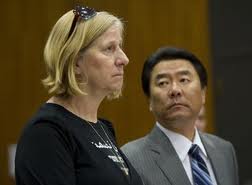 |
| CINDY WITH ATTY JOSH KAIZUKA IN COURT |
The City of Sacramento refuses to allow Occupy Sacto to remain in Caesar Chávez Park after 11pm, so some of the activists commit civil disobedience on some nights to challenge the law.
On the night of Saturday, October 15th, 19 of us decided to stay in the park and we were arrested for, "Refusing to leave the scene of a riot," (it was the most boring and peaceful "riot" I had ever been to) and "Violation curfew." Excuse me? I am 54 years old and don't have a curfew. Anyway--several dozen of us were arraigned on November 3rd and our trials are set for December 13th.
I have read that each trial will cost the city about $10,000 per defendant and so far, there are about 80 of us who refused to take the plea agreement (which I am not even sure what it was because we are in for the whole enchilada--we aren't doing anything wrong, in fact we are being uber-correct).
One very miraculous thing is that the legal community of Sacramento has rallied around the Occupy activists and we actually had more attorneys offering to help us the day of our arraignment than we had defendants.
I am linking some articles that are pertinent to the case.
FEDERAL JUDGE BACKS CURFEW AT OCCUPY SACTO
CINDY SHEEHAN LEADS MASS ARRAIGNMENT
CINDY SHEEHAN SPEAKS AFTER ARRAIGNMENT
FROM OWS to RRC by Cindy Sheehan

From OWS to RRC
Cindy Sheehan
Recent events at Occupy movements, particularly in Oakland, Denver, Atlanta, Portland and Chicago, where hundreds were arrested and some seriously injured—it’s becoming clear that when we in the Robbed Class allow ourselves to be contained in a small, easily attacked geographic location, we open ourselves up for Imperial Abuse and more Police Brutality. As a non-violent movement, we the people do not have the tools or the will to be involved in a war against the Police State. We will lose, especially if we are inclined to confine ourselves to easily surrounded city parks.
Remember the tales we were told in grammar school about our great revolutionary leaders who became almost like guerrilla warriors during the war for independence? How they learned how to break the easily attacked ranks and fight like the “Indians?” Can you imagine the people in the countries occupied by the US gathering in local parks and telling US troops thus making it easy to find them and obliterate them?
Obviously, the United Police States of America knows no constraint on its violence. There is a similar lack of accountability for the goon squads or the people who order them to do attack innocent people. As someone who has watched Occupy Sacramento spend more time fighting with the city to allow its encampment to remain set up in the park than actually confronting the issues I think maybe it’s time to move from occupation to solution in smaller, yet connected groups of Robbed Class insurgency?
Since the beginning of 2009, I have been urging people to break their chains of slavery with the Robber Class--that is now happening. The Robbed Class is waking up to the fact that we have been co-dependent with the crimes of the Robber Class for generations now and that cycle must be broken. But what are some of the major institutions or practices that enlarge this vast income and social inequality?
The major problem is that here in the US basic human rights are sold to us as “privileges” that we must either be born into or sell our souls to the corporate devil to obtain—but even that option is disappearing with the outsourcing of jobs and the growth of predatory credit systems. Meaningful work that doesn’t make one want to scrub the stench of the regret of selling-out is very hard to come by lately in the “wealthiest” nation on the planet.
What are basic physical human rights as outlined and recognized by the international community?
The right to peace;
The right to health care;
The right to a clean and sustainable environment;
The right to housing;
The right to education;
The right to healthy food free from genetically modified organisms;
The right to clean water;
The right to a meaningful job paying a living wage;
And the right to organize into true democratic systems.
My book, Myth America, 20 Greatest Myths of the Robber Class and the Case for Revolution presents an argument against being co-dependent with the Robber Class and offers many do-able solutions to build healthy, healing, peaceful and sustainable communities. Re-Creating Revolution Communities (RRC) begins the hard work of siphoning off the power and resources from the Robber Class and keeping it in our own communities and making civilization work for us.
Another grave, but not insurmountable problem we have here is a vertical, hierarchical power structure—the solution is horizontal, grassroots, decision-making and power sharing.
Bluming Brilliant: William Blum on Cindy Sheehan's Soapbox

Saturday, November 5, 2011
Transcript of Soapbox Interview with Dr. Justin Frank

CS: Cindy Sheehan
JF: Justin Frank
CS: Welcome back to Cindy Sheehan’s Soapbox. I am your host Cindy Sheehan and you are listening at CindySheehansSoapbox.com.
Today my guest is a dear friend of mine, Dr. Justy Frank, or Justin Frank, who practices and teaches psychoanalysis in Washington, DC and is Clinical Professor of Psychiatry at the George Washington University Medical Center.
A clinician with more than thirty year's experience, Dr. Frank has been a former columnist for Salon.com, DailyBeast.com, and continues to be a frequent contributor to HuffingtonPost.com on topics as diverse as politics, film, and theater. He employs the principles of applied psychoanalysis to assemble the kind of psychological profile used in his previous best-selling book Bush on the Couch (Regan Books 2004, 5, 7) in his new book Obama on the Couch: Inside the mind of the President, released October 18, 2011 by FreePress/Simon&Schuster he does the same thing.
Dr. Justy Frank welcome to Cindy Sheehan’s Soapbox.
JF: Thank you. Pleasure to be here.
CS: I should say welcome back to Cindy Sheehan’s Soapbox because you’ve been on before.
JF: Yes I have, in the very early days.
CS: Yes, the early days of Cindy Sheehan’s Soapbox. So you’re on because you just published a new book called Obama on the Couch, which I guess I don’t know if you can call it a sequel to your book Bush on the Couch. First of all before we talk about your new book why don’t you tell us about Bush on the Couch and about your methodology because I think it is relevant for your new book also?
JF: Well it’s an old methodology called applied psychoanalysis which is taking psychoanalytical principals and applying the principals of psychoanalytical work which was originally pioneered by Freud, applying that to working with people who you don’t get to see in your consulting room like public figures sometimes even fictitious people. I mean there has been lots of psychoanalytic studies say of Hamlet. But we are familiar of political figures. Everybody knows for instance, well not everybody but lots of people know that Lincoln was depressed. There have been several extensive psychoanalytic studies about Lincoln and it involves finding out everything you can about them. Which means in Obama’s case and in Bush’s case well in Obama’s case in particular he had written two autobiographies so that is a lot of information. Plus there is all the things you get to watch in press conferences, speeches, behavior, public behavior actions and all of that.
So it’s essentially looking for patterns. Looking for ways, different things that to help understand the person better and really think about them. The CIA does it all the time now with hiring psychologists and psychoanalysts to analyze foreign leaders. Roosevelt himself hired a psychoanalyst. He was the first one to start this in the political world. He hired a well known psychoanalyst named Fritz Redlich to analyze Hitler because he thought he’d like to know how to deal with Hitler should they have to negotiate after the war. Neither of them lived through the war so it never happened but the book was printed. So anyway that’s what I do and it’s actually very interesting and very thorough time honored technique.
CS: Well it must be on the one hand easier these days because you have more video and audio and material but then that must also make it harder because you have more video, audio and material to go through.
JF: You got it exactly right. It is easier and harder. The mass of material and information and he certainly, he gives these weekly Saturday broadcasts, so did Bush but he does much more public appearances than Bush did when he was President. So it’s a lot of material. There’s no way for it to be comprehensive you know, that’s always been a problem with doing psychoanalysis because I only hear in normal situations when I am working with a patient intensively sometimes five times a week I still only hear what they tell me about so I don’t know about their lives the rest of the day except what they tell me. In a way their analysis goes on on their own too. So with Obama it is actually harder. There’s so much material and I have to start selecting things. That’s frustrating.
CS: I just got your notice the other day that your book was coming out and so I had my producer Mikey arrange this interview so it was very quick and I haven’t received my copy of the book yet so I have to admit that I haven’t even looked at it. I am anxiously waiting for it.
JF: You’ll get. You know they had a thing where they said they couldn’t deliver it over night to a PO box and I should have called you for an address that I could have given them but I’ve been so swamped myself.
CS: I am sure you have.
JF: So why don’t we talk about it now. And why don’t if you read it and don’t like it I can come back in a month or two or whatever you want and then we can talk about it again. Cause I know you will have some interesting observations. I know you too well.
CS: Pretty soon it will be Cindy Sheehan on the Couch.
JF: Well I don’t know about that. I don’t do that with people I know so you’re safe.
CS: Okay cool. So anyway tell us about the book. Tell us about Obama on the Couch and what you concluded.
JF: Well the book is slightly different than Bush on the Couch initially because I really liked Obama and I was really frightened of Bush I initially thought that he was psychologically unstable and dangerous which I think history has born out. Whereas Obama I felt like I don’t have to see a psychoanalytic study as a kind of weapon to warm people. It’s much more a chance to get to think someone and get to know them and look at some of their issues. But the motivation for the book was that I was actually stunned and this may be more about me than about Obama. And I don’t think you were stunned actually.
CS: No I have to say that I’m not surprised by what’s been going on the last three years but I am a little stunned that it is actually worse than I thought it was going to be.
JF: Yes I think so too and I was stunned by the discrepancy between candidate and president and I was trying to understand what that was. And I knew that when he was a candidate he was not a real liberal guy. I mean I know enough about that I’ve been studying that so that was not a surprise to me. That he even took on guys like Geihtner, Summers and those people. The surprise to me and what’s in the book is about his paralysis at times. Like when there’s the oil spill and he doesn’t react. Or when there are things happening that are terrible he doesn’t react.
This disconnect between that and this methodical campaign where he just went after Hillary then he went after John McCain and he was clear and focused and strong and then even when he had bin Laden murdered it was like focused and decisive and he did it in this focused way where he was at the Press Club the night before joking around and it was the night it was going on. He was amazingly focused and yet when he is dealing with republicans, when he is dealing with his own party, when he’s dealing with congress he seems tentative and indecisive and almost paralyzed. In fact Gail Sheehy who read the book wrote a blurb on the back and said she thought he was neutered. She used the word neutered.
You know that’s after reading the book. That’s what I was beginning to, what really bothered me so I wrote this book looking in to why he was like this. One of the things I figured out is that the way he used the word change and the way that we understood, we meaning the way most people understood change was dramatically different. Most people felt he meant change away from Bush and change away from Bush’s policies like war, like Guantanamo, like economic dishonesty and unfairness, like tax breaks for the wealthy. All of those things.
CS: Right.
JF: Environmental, you know how Bush ignored the environment, ignored the Kyoto accords. So I mean the change meant a change away from that it seems like. But I don’t think that is what he meant. In researching him I don’t think that is what he meant by change.
CS: Well I say that an awful lot. You know, I say that change could mean so many different things to so many different people. And even though he didn’t mean change away from the Bush policies to me I think that he was very happy to let his supporters believe that is what he meant.
JF: I agree with that. He was very happy to be what we call in my field a projection screen. A blank screen where you project your own hopes and dreams and wishes and he allowed himself to be that and I think he actually I agree with what you said. He liked that.
CS: He did actually say that right?
JF: He did say that. He said that at one point. I don’t remember where but he did say that. During the campaign even. So I think in that sense he likes the mystery and being a blank screen and he knew in that sense he was manipulating people. I think that’s right. And that’s what I didn’t write as much about in my book as I did that we the people, that he did mean change but he meant change in a way that was very idiosychcratic to him because of his upbringing.
CS: Talk a little bit about that. Talk about what you found out.
JF: Well first of all the change he meant was change towards civility where people could actually have dialogue and discuss and that’s why he became a community organizer originally. That’s his interest. His interest is to get people to see what they have in common. That was his speech in 2004 about no red states or blue states. It’s been a focus even when, even after he made the announcement about Bin Laden. He ended that brief announcement with something about we are all in this together kind of thing.
When he talks that every chance he can. So why does he do that? As a child he was first of all bi-racial. So he had a black face and he was raised, surrounded by a sea of white faces. So that’s the first thing. The second thing is his father abandoned him when he was a baby. Abandoned the family. Not when he was two like people are saying but when he was a baby. And then his mother remarried and then he had a stepfather that he was very close to and the stepfather taught him how to box, how to defend himself.
The stepfather, he even writes that his step father was like the ground he walked on and the air he breathed he was really that intensely involved with him and then his mother took him away from the stepfather when he was ten with the overt reason and I don’t know why fully, the overt reason was that she felt that her son was becoming too Indonesian and wanted him to become more American and go to American school. So that was the second broken home. In other words. So he grew up by the time he was ten he was from two broken homes. He never had a father after that. He had a father that he yearned for. He met his natural father only for a month when he was about ten and that was it. So the next father figure he had I think in any deep meaning was Reverend Wright and that’s much later in his life.
CS: What about his grandfather? Wasn’t he…
JF: His grandfather…
CS: Didn’t he spend al lot of time with his grandparents?
JF: Yes, he spent a lot of time with his grand parents but his grandfather was a drinker who was not very focused and was sort of dismissed as an authority figure or as a wise person by the grand mother yet alone by the grandson. But the grandmother was strict and there and focused so she really helped raised him a lot and was very much involved. So he did have, he didn’t have like nobody there. And in fact his mother, the irony is though that his mother was there in a way that was really inconsistent because she was there and she abandoned him to pursue her own interests in anthropology when she went to these remote Indonesian locations.
And at one point in the book I came with the thought that he really had to struggle with his feelings about his mother because he adored his mother. He needed his mother and yet she was the only person that was so intimate and intense with him at the same time. He was probably really angry with her for pushing him but also for leaving him. She would push him then leave. So I started thinking about that and I was wondering I know, I mean I don’t know what your kids did you know because your son was killed so it’s very different. But I don’t know how your kids, I don’t remember how old your other kids were when you started traveling and speaking out.
CS: Well they were all 19 and above but still they had some difficulties with the dramatic way and traumatic way our family life changed.
JF: It was really dramatic and traumatic. And I think what happened with him was that he was a little boy and he had no siblings at the time. I mean he didn’t even have a sibling until he was nine. So he didn’t have what your kids had for growing up. Then his mother would not be around so then he never protested his mother being away. You know I had this idea, why couldn’t he say, you know I opened a restaurant when my son was six and man was that dump and I am a psychoanalyst. I was gone a lot. This was really dumb. And Joey said to me at one point, what’s more important Dad, a Dad or a restaurant? A boy or a restaurant? And that stuck with me. That was the last day I cooked at the restaurant by the way. I just said, you are right.
CS: Justy the way our society is that there are very few families that are untouched by financial difficulties or other stresses that are really pressing the average or normal American family or the 99 percent what the Occupy Wall Street people will say. You know we know that what they call a so-called family with a mom and dad at home, you know dad working and mom staying home..
JF: Those are the exception to the rule.
CS: Yeah so we’re probably from now on going to be facing this with just about everybody that runs for President now or seeks the office of the President. And what do we do when it is probably not the man or the woman that really is in charge of the empire. What do we do when the empire is so diseased?
JF: Well first of all there’s more than one way to be away.
It always hurts a child or the mother or the father when they’re not spending as much time with them or they leave. It makes them feel bad. Makes everybody feel bad and the necessity is the necessity. But there’s more than one way of attaching to your children and for them to attach to you. There’s lots of different terms for this and I really didn’t get in to that in my book but I think it’s important, very important. One of them is called anxious attachment, one is called dismissive attachment and the other is called like pursuing attachment.
I forget what it is called but it is where you always want more, where you go after your mother or father for more. Or the dismissive one is where you get your feelings hurt and boom, you cut yourself off and you don’t feel it and I think that’s what happened to Obama. I think it doesn’t have to happen that way that when people are working and they’re busy and trapped by our diseased system and everything, have to work to make ends meet and you know we are in a system that is not a good one right now. I mean it never was but now it’s coming to fruition.
CS: Can I just give you my impression of Barack Obama when I had a sit down meeting with him back in 2005 and then have you comment on it because we un believable only have a few minutes left.
JF: Oh no!
CS: I know it goes by so fast I can’t believe it.
JF: I thought it was an hour. I didn’t know.
CS: Oh gosh, no, no, no it only works out to be about 25 minutes for an interview.
JF: Tell me your impression.
CS: It’s been fascinating so far and then of course we will have you back on after I read your book for sure.
JF: Good.
CS: So after Camp Casey in 2005 I was pursued by the Democratic Party. You know they recognized the power of the antiwar movement in the United States at that point. I met with everybody. I met with Nancy Pelosi, Hillary Clinton, Harry Reid, John Kerry, you know from Congress people, a lot of Congress people both Democratic and Republican and they were very open meetings where their staff would be there, my staff would be there. My staff who was really my sister who ran behind the scenes…
JF: I remember your sister. She was great.
CS: And half the time her stupid phone would go off and she had the Benny Hill them music on it. I would look at her and go," really, by now you’re not turning your ringer off?" But anyway then there would be press and everything. Barack Obama insisted that it just be he and I. No press. None of his staff, none of my staff and um…
JF: He was the only one who did that?
CS: Yes, the only one that did that. You also know me very well that when I am out on the protest line it’s shorts and a protest t-shirt. So I had been going from Crawford Texas to Washington DC. It took us 3 weeks to get there. Stopping, flying and very busy. So I am still mostly in my protest attire. I walked in and the first thing he did was criticize the way I looked. Then he was very, very sarcastic, very dismissive of my input and I got the impression almost the same as when I got the face to face with George Bush..
JF: Yeah, it sounds very much like him.
CS: it was an arrogance and it was also like you said earlier a detachment from humanity. Of course I got the same impression from Hillary Clinton and most of our elected officials are to some degree bought. But a lot of them still have an ability to empathize with people. But I didn’t get that feeling from George Bush or Barack Obama.
JF: So interesting. And I have a question. Was this when he was already President or Candidate or was a Senator?
CS: He Senator was in 05’
JF: So it was early before he even ran for the Senate? Oh no he was a Senator.
CS: He was in the Senate. Yeah he was a Senator at that point.
JF: Right.
CS: But he was also the super star of the Democratic Party.
JF: Right. So this was in 05’. Oh my God. Oh my goodness. Well I’m a little speechless. I want to think about that because I think he, the thing that I thought about him and maybe he’s different form the way he is. I am curious how he is with men and with women? Because I think he is seductive not in a sexual way but seductive in a way where people feel listened to and attended to. I wonder if he is more seductive towards men that way and he feels that they feel that he pays attention and listens to them. Because I know several people and they’re women too who say they’ve never met a person who listens better than him.
CS: Oh well that wasn’t my experience.
JF: No! Not at all.
CS: I mean as soon as I was in the door he was on the attack. Attacking my appearance.
JF: God.
CS: Then of course it was the whole; we’re going to do this. And so when he was campaigning on transparency I thought that was pretty ironic considering my own personal experience with him. Our meeting was just he and I and you know of course there was no record of our meeting or anything.
JF: I am aware now of time but you’ve got me worried that Bush taught me that national politicians, especially national ones, whenever they say something about a major idea you always have to think that they also mean the opposite. So when he says I am a uniter not a divider you have to think that he is a divider. When he says he is a compassionate conservative you have to think that he is not compassionate.
Well I thought that way about Obama when he said transparency meaning he’s not transparent. But I didn’t focus on that because I was so struck by this what I call obsessive bipartisan disorder that he has that everybody get along and that blinds him to everything else. It leads him to be paralyzed. But I think you are right about transparency and even change you could say. I was writing I thought it should be called Change you can’t Believe in. Or Change you Shouldn’t Believe In. I have a chapter in the book that says he’s afraid of change.
CS: Well I can’t wait to get your book Justy and can you tell my listeners how they can get a hold of their own copy or contact you if they have any questions or comments?
JF: First of all I have a website called Justin Frank that’s very simple. Or Obama on the Couch. Either one .com. It tells about contacting me and all that and they’re reviews of the book. The cheapest way to get the book if you have a computer is Amazon.com because its listed $26 and they are selling it for $16.
CS: All right.
JF: Bookstores, you can get it at any bookstore and it also comes in e-books in terms of Kindle and all that stuff. So you can get it in any form you want and it’s available widely. It just came out and you’re interviewing me the day after the book was released.
CS: Yay!!
JF: So this is very immediate. It’s the longest interview I’ve had even though you had to cut it off. So that’s how you get the book and it’s pretty straight forward to get, It’s got, one of the things that’s different about it is it’s got a chapter called, Our Obama, and a chapter called, Their Obama, and a lot of those chapters are focusing on the people who support him and the people who attacked him in the beginning. Thinking about their psychology and what he means to them. The second thing that makes it different is that there is a glossary of terms at the end so in reading it you’re not stuck with psychoanalytic stuff.
CS: Um huh, jargon.
JF: Jargon, it’s very readable. I think it’s very readable.
CS: Yeah, your book Bush on the Couch was a super interesting and fast read so I’m really looking forward to my copy and Justy my friend, as you are my friend, my personal friend, how’s the family?
JF: The family is good. My middle son is Abe is in Los Angeles making money from tutoring kids for college boards, for SAT’s to pay his rent so he can write screenplays. So he is a struggling writer. My oldest some Joey, I guess you know he made a movie and won Sundance Grand Prize so I am very proud of him winning the Sundance award.
CS: No kidding!
JF: Yeah, it was a documentary about Brazil, about corruption in Brazil and it’s really good. Then my daughter that you know, Ginevra, well you knew Joey too the oldest, the first-born. Ginevra is finishing up her senior year at the University of Maryland. So they’re all moving along and Heather is great. She’s got this big job so she can’t work for the book or anything with it. She is now Vice President at USA Today.
CS: Wow! So now that the book is finished then you should be in better touch.
JF: I will definitely. I will guarantee you. Scouts honor I will.
CS: Okay Justy. Thank you so much for being on Cindy Sheehan’s Soapbox today.
JF: You’re welcome. I love you.
CS: Talk to you soon. Love you too.
THANKS TO THE BENNY HILL PERSON IN THIS STORY FOR TRANSCRIBING THE SHOW--DEDE MILLER--
Wednesday, November 2, 2011
Mass Arraignment in Sacramento to include Cindy Sheehan
MEET AT 8 AM THURSDAY OUTSIDE the courthouse on 9th St. side
For immediate release
Wednesday, November 2, 2011
DAY 28/Wednesday/UPDATE:
Cindy Sheehan leads 30 Occupy Sacramento
defendants to mass arraignment Thursday;
courts balk at other 'occupier' cases
SACRAMENTO – Anti-war Mom Cindy Sheehan and 29 other Occupy Sacramento defendants will appear in the largest mass arraignment yet this THURSDAY – even as Sacramento Superior Court judges try to stop the constant barrage of "occupiers" into the courts.
Sheehan and the others will be arraigned at 8:30 a.m. Thursday in Dept. 3 and 4. They will hold a media availability outside the courthouse (720 9th St.) at 8 a.m.
The trial courts Wednesday refused to let additional occupiers be arraigned Thursday because it became apparently the courts can't handle the load.
83 arrests have been made at Occupy Sacramento at Cesar Chavez Park since Oct. 6. Dozens of people still have not had their court dates. Thursday will be Day 29 of the occupation.
All are expected to plead not guilty, reject any offer by the City of Sacramento and demand a jury trial.
A temporary restraining order requested of the federal court to permit "occupiers" to continue their free speech activities 24 hours a day and prevent the City from continuing arrests will be heard late Thursday afternoon. The lawsuit will continue even if the TRO is turned down.
For immediate release
Wednesday, November 2, 2011
DAY 28/Wednesday/UPDATE:
Cindy Sheehan leads 30 Occupy Sacramento
defendants to mass arraignment Thursday;
courts balk at other 'occupier' cases
SACRAMENTO – Anti-war Mom Cindy Sheehan and 29 other Occupy Sacramento defendants will appear in the largest mass arraignment yet this THURSDAY – even as Sacramento Superior Court judges try to stop the constant barrage of "occupiers" into the courts.
Sheehan and the others will be arraigned at 8:30 a.m. Thursday in Dept. 3 and 4. They will hold a media availability outside the courthouse (720 9th St.) at 8 a.m.
The trial courts Wednesday refused to let additional occupiers be arraigned Thursday because it became apparently the courts can't handle the load.
83 arrests have been made at Occupy Sacramento at Cesar Chavez Park since Oct. 6. Dozens of people still have not had their court dates. Thursday will be Day 29 of the occupation.
All are expected to plead not guilty, reject any offer by the City of Sacramento and demand a jury trial.
A temporary restraining order requested of the federal court to permit "occupiers" to continue their free speech activities 24 hours a day and prevent the City from continuing arrests will be heard late Thursday afternoon. The lawsuit will continue even if the TRO is turned down.
Subscribe to:
Posts (Atom)
POPULAR POSTS
-
 FIRST PUBLISHED IN GLOBAL RESEARCH “The goal of modern propaganda is no longer to transform opinion but to arouse an active and m...
 -
There is always a war on the poor, working-poor, and working-class This episode of The Soapbox reunites Cindy and Mickey-Z who may b...
-
In 2005 while I was roasting for peace under the hot Texas sun at Camp Casey in Crawford, Tx, Rob Reiner sent his wife Michelle and a cre...

